
Prime vs. Zoom Lenses for Dogs in Action Photography: Which One Should You Choose?
When you're photographing a dog sprinting at full speed, launching off a dock, or leaping for a ball mid-air, your choice of lens can make or break the shot. Prime vs. zoom lenses for dogs in action photography is one of the questions I get asked most often, so let's settle it once and for all.

After years of capturing high-speed canine motion around the world, here's the honest truth: there's no single "better" lens. Prime and zoom lenses are both powerful tools, they just serve very different creative and technical purposes. Here's my complete breakdown, so you can decide what fits your style and your next session.
⚡ What Makes a Prime Lens Different
A prime lens has a fixed focal length: no zooming in or out, you move your body to reframe the shot. That constraint comes with real technical advantages for extreme action work.
1. Maximum light, faster shutter speeds
Primes usually offer much wider maximum apertures — f/2 or f/2.8 is common on the lenses I use. That extra light hitting the sensor lets you push shutter speeds to 1/2500s or beyond, even as natural light starts to drop in the late afternoon or in overcast conditions.
2. Surgical sharpness and background separation
With fewer internal glass elements moving around, primes deliver optical sharpness that's hard to match, plus the kind of buttery, smooth background blur (bokeh) that completely isolates a running dog from a busy or messy background.
3. Blazing autofocus performance
Less glass movement inside the lens means the autofocus motor can drive focus elements faster and more precisely, critical when you're tracking a dog running directly at the camera at 50 km/h.
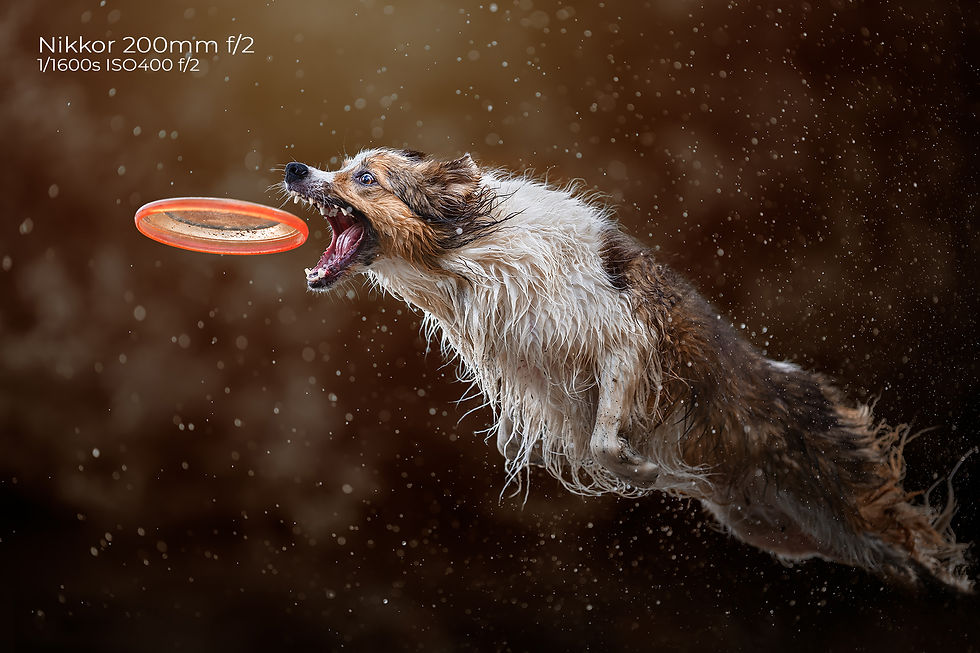
My personal go-to primes: the Nikkor 200mm f/2 and Nikkor 300mm f/2.8. The subject isolation and autofocus speed they deliver for dog action work are, in my experience, unmatched by anything else in my bag.
🔍 What Makes a Zoom Lens Different
A zoom lens — something like a 70-200mm f/2.8 or a 100-400mm — lets you change focal length on the fly, without moving your feet or swapping glass.
1. Adapting to unpredictable movement
Dogs don't run on fixed tracks. If a dog unexpectedly changes direction, or comes in much closer than you planned, a zoom lets you pull back instantly instead of clipping paws or tail out of the frame.
2. One lens, multiple compositions
You can capture a wide environmental shot of a dog mid-leap, then a split second later zoom in tight for a dramatic close-up headshot — all without changing lenses and risking missed moments.
3. The trade-offs
Modern professional zooms are genuinely fast and sharp, but they're generally heavier than primes, have a slightly narrower maximum aperture, and involve small optical compromises to cover that focal range.
Prime vs. Zoom Lenses for Dogs in Action Photography: Side-by-Side Comparison
Factor | Prime Lens | Zoom Lens |
Max aperture | Wider (f/2–f/2.8) | Slightly narrower |
Weight | Depends | Heavier in general |
Sharpness | Maximum | Excellent, marginally less |
Autofocus speed | Fastest | Very fast |
Background separation | Best-in-class | Very good |
Framing flexibility | None, fixed focal length | High |
Best for | Known distance, extreme speed | Unpredictable, wide action areas |
Which Should You Choose? A Scenario Guide
Shooting on a beach or open field where the dog's path is unpredictable? Go zoom, you need to react in real time.
Shooting a controlled sprint or retrieve at a known distance? Go prime, you'll get maximum sharpness, speed, and separation.
Shooting a single session where the dog might come close, run wide, or leap unpredictably? A zoom gives you the safety margin.
Building a portfolio piece where background separation and technical polish matter most? A prime is worth the extra planning.
Final Thoughts
Neither lens type is objectively "better", the right choice depends entirely on the scene in front of you and what you're trying to capture. Most working dog action photographers, myself included, end up owning both and choosing based on the session, not on brand loyalty to one type of glass.
Want to Master This Yourself?
Gear is only half the equation, the other half is technique: reading the dog's movement, anticipating direction changes, and nailing focus at 50 km/h. That's exactly what we work on inside the Dog Photography Master School, through hands-on workshops and courses. [Explore the Offer → Education - Workshops ]


Comments